

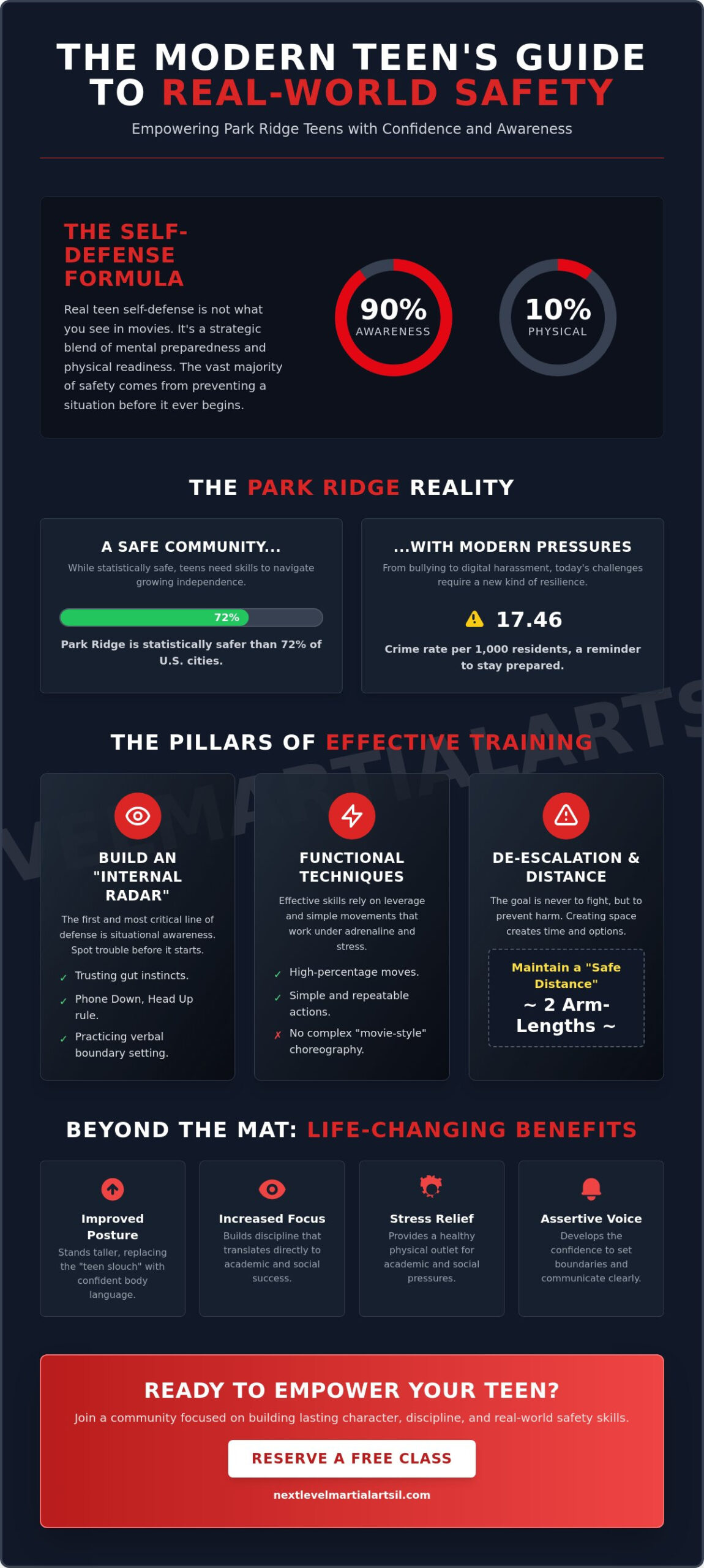
Real teen self-defense is 90% awareness and boundary-setting, and only 10% physical technique. While Park Ridge is statistically safer than 72% of U.S. cities with a crime rate of 17.46 per 1,000 residents, your teenager still faces modern pressures like bullying and digital harassment. You want your child to walk through South Park or their high school hallways with their head held high instead of slumped in a “teen slouch.” Finding the right self defense for teens Park Ridge offers is about more than just learning to punch. It’s about building an internal radar that spots trouble before it starts.
We know you want your teen to feel capable and secure in any environment. This guide shows you how specialized training empowers Park Ridge teens with the physical skills and mental toughness to navigate 2026 safely. You’ll learn how local programs turn stress into a healthy physical outlet while teaching practical ways to de-escalate conflict. We’ll also preview how consistent practice builds the “internal radar” your teen needs to stay safe. Let’s explore how the right martial arts environment creates lasting confidence and safety for your family.
Key Takeaways
- Learn why effective self-defense starts with mental awareness and assertive communication to stop trouble before it ever escalates.
- Discover how functional movement and simple, high-percentage techniques make self defense for teens Park Ridge more effective than complex choreography.
- Compare the unique benefits of Taekwondo and Karate to find the discipline that best aligns with your teen’s personality and safety goals.
- Master practical daily safety habits like the “Phone Down, Head Up” rule to navigate modern digital distractions safely.
- Understand how an “Encouraging Mentor” philosophy builds lasting character and discipline that extends far beyond the martial arts studio.
Why Teens in Park Ridge Need Specialized Self-Defense Training
The transition from middle school to high schools like Maine South or Maine East marks a major shift in a young person’s life. It’s often the first time Park Ridge teens experience true independence. They’re walking to Uptown for lunch, hanging out at the library, or taking the Metra into the city with friends. While our neighborhood is statistically safe, preparing for life outside the “Park Ridge Bubble” is a vital part of growing up. Enrolling in self defense for teens Park Ridge programs helps bridge the gap between being a protected child and becoming a capable young adult. This training provides the physical tools and mental framework to handle new environments with quiet poise.
Physical competence directly translates to academic and social success. When a teen knows they can protect their personal space, their posture changes. They stop slouching and start making eye contact. This shift in body language often prevents bullying before it starts. Martial arts training also acts as a powerful stress reliever. By providing a healthy outlet for physical energy, it reduces the anxiety many students feel regarding grades and social standing. We focus on building a resilient mindset that views challenges as opportunities for growth rather than sources of fear.
Beyond the Mat: Addressing Modern Teen Challenges
Navigating the complex social hierarchies at local high schools requires more than just good grades. The psychological impact of knowing you can defend yourself is profound. It builds an internal “safety net” that allows teens to be more assertive in their daily lives. Traditional sports are excellent for fitness, but they often miss the specific character development found in martial arts. We teach teens that their greatest weapon is their mind. For a comprehensive overview of self-defense and its legal boundaries, it’s clear that avoidance and de-escalation are the primary goals. Our students learn to carry themselves with a level of discipline that commands respect without aggression.
Building the Internal Radar: Situational Awareness
Most dangerous situations are avoidable if you recognize the signs early. We help teens develop an “internal radar” to spot red-flag behaviors in both peers and strangers. This situational awareness is a skill that lasts a lifetime. We use practical drills to help students stay alert while navigating public spaces. Key areas of focus include:
- Trusting Gut Instincts: We teach teens that if a situation or person feels “off,” it’s okay to leave immediately without worrying about being polite.
- Digital Awareness: Learning to look up from the phone while walking through the South Park facility or waiting for a ride.
- Verbal Boundary Setting: Practicing clear, assertive communication to stop unwanted attention or peer pressure before it escalates.
By practicing these skills in a supportive environment, teens gain the confidence to trust their own judgment. This awareness is the first and most important line of defense in the real world.
Essential Skills: What Makes a Teen Self-Defense Program Effective?
Many local programs focus on winning trophies or mastering complex choreography. While sport karate is excellent for fitness, self defense for teens Park Ridge requires a different approach. Real-world safety isn’t about points or judges; it’s about practical skills that work under pressure. Effective training prioritizes functional movement over “movie style” moves. We teach high-percentage techniques that rely on physics and leverage rather than raw strength. When adrenaline spikes, fine motor skills often disappear. That’s why we focus on simple, repeatable actions that a teen can recall instantly during a stressful encounter.
Understanding the difference between “fighting” and “self-defense” is critical for students in the Maine Township school districts. Most schools have strict zero-tolerance policies regarding physical altercations. We teach teens that self-defense is a legal and moral necessity used only to prevent harm. It’s about de-escalation and creating a “Safe Distance.” If a teen can maintain two arm-lengths of space, they have the time to react, move, or call for help. Maintaining this reactionary gap is often the difference between a controlled situation and an uncontrolled confrontation. If you want to see how we balance these skills, reserve your first class and experience our community-focused environment.
Physical Techniques: Simple, Effective, and Age-Appropriate
Physical training focuses on escaping common holds, such as wrist grabs or bear hugs, which are frequent in peer-to-peer bullying. Instead of trying to out-muscle an opponent, students learn to target weak points like the thumbs or balance. Striking basics are taught as a tool to create an opening for escape. We show teens how to generate power from their legs and hips so size becomes less of a factor. Effective self-defense is the ability to escape safely rather than win a fight. This mindset ensures that the teen’s primary goal is always to return home unharmed.
Verbal De-escalation: The Power of Assertiveness
The “Voice as a Shield” is often more powerful than any physical strike. We use role-playing scenarios to help teens practice saying “No” firmly and clearly. Setting boundaries with peers can be socially difficult, so we teach the “broken record” technique. This involves repeating a simple, assertive statement without getting drawn into an argument or negotiation. Body language plays a huge role here too. By keeping their chin up and shoulders back, teens project a level of confidence that often deters potential bullies before a word is even spoken. These “soft skills” are essential for navigating the social complexities of 2026.
Evaluating Your Options: Martial Arts vs. Specialized Self-Defense
Picking the right program for your teenager is a major decision. Many parents look at local offerings and see a variety of names like Shotokan, Taekwondo, or Jiu-Jitsu without knowing which fits best. When searching for self defense for teens Park Ridge, look beyond the name on the door. You want a program that balances traditional discipline with modern, practical application. Taekwondo is an excellent choice for teens who enjoy movement and agility. It emphasizes high, fast kicks and Olympic-style competition, which builds incredible cardiovascular health. Karate typically focuses on structural power and traditional kata. Both styles offer discipline, but the best programs for 2026 are those that adopt a “growth center” philosophy.
Avoid “fight club” environments that prioritize aggression or high-pressure competition over personal development. Instead, seek out a studio that feels like a community hub. A growth-oriented center focuses on how martial arts can improve a teen’s life outside the dojo. This includes better focus in school, increased respect for others, and the confidence to handle social pressure. A hybrid approach is often the most effective. By combining the agility of Taekwondo with the boundary-setting skills of modern self-defense, teens get a well-rounded education in personal safety. This ensures they’re prepared for the real world and so much more.
Taekwondo vs. Other Styles: Which Fits Your Teen’s Goals?
Many students start with kids martial arts foundations and naturally progress into teen programs as their needs evolve. Taekwondo offers a significant advantage in speed and reach. This allows a teen to keep a potential threat at a distance, which is a key component of staying safe. In contrast, styles like Jiu-Jitsu focus on close-quarters grappling. For most Park Ridge families, the striking and distance management of Taekwondo provides a solid base for self-protection. It’s about finding a balance between the respect of traditional values and the reality of modern safety challenges.
Group Classes vs. Private Training for Personal Growth
Training with a group is often the best way for a teen to build social skills. It creates a sense of healthy competition and provides a safe space to practice de-escalation with peers. Our community-oriented approach helps teens find their “tribe” in a supportive environment. This is especially helpful for students who might feel like they don’t fit into traditional school sports. Group classes teach:
- Social Resilience: Learning to work with different personalities and skill levels.
- Peer Support: Building friendships based on mutual respect and shared goals.
- Practical Application: Practicing techniques against various body types and sizes.
Private training is another option if your teen needs focused skill development or has a specific goal. One-on-one sessions allow an instructor to tailor the pace to the student’s needs. Whether in a group or a private setting, the goal remains the same. We build people, not just fighters. This focus on character development is what makes self defense for teens Park Ridge such a valuable investment. Come see us and discover how we make martial arts a tool for life improvement.
Practical Safety Strategies for Teens Outside the Studio
Self-defense doesn’t end when the class timer stops. It’s a mindset that follows your child everywhere. In 2026, the biggest threat to awareness is the smartphone. We teach the “Phone Down, Head Up” rule to help students stay alert while walking through Uptown or waiting for a ride. By keeping their eyes on their surroundings instead of a screen, teens can spot potential issues 20 feet away rather than two feet away. This simple habit is a cornerstone of self defense for teens Park Ridge training. It ensures they aren’t an easy target for opportunistic trouble.
Teens must also master the OODA Loop: Observe, Orient, Decide, and Act. This mental framework allows for split-second decisions in high-pressure moments. First, they observe the environment for anything unusual. Next, they orient themselves by identifying exits or safe zones. They then decide on a course of action and act immediately. This process reduces the “freeze” response that often happens during a confrontation. Whether they’re on a crowded PACE bus or walking with friends, the “buddy system” remains a vital layer of protection. There’s always safety in numbers.
Confined spaces like school hallways or buses require specific tactics. We teach students to avoid being “pinned” against a wall or locker. Staying mobile is key. If a teen feels cornered, they should move toward an open area immediately. This proactive movement often stops a physical confrontation before it begins. To see these strategies in action and help your teen build real-world awareness, come see us for a trial week and meet our team.
Digital Self-Defense and Social Media Boundaries
Online confidence mirrors physical confidence. We show teens that standing up to cyber-bullying starts with clear digital boundaries. This includes strict privacy settings and being selective about location sharing. A teen’s digital footprint is permanent. Understanding this helps them manage their online actions with the same discipline they use on the mat. By treating their digital space with respect, they protect their reputation and their mental well-being.
Navigating Social Pressure and Peer Conflict
It’s important for teens to recognize the difference between harmless teasing and actual harassment. Teasing is usually between friends and isn’t meant to hurt. Harassment is persistent, unwanted, and intended to cause distress. When social pressure builds, staying calm is the most effective response. The same adult taekwondo principles of self-control apply to teen social conflicts, allowing them to respond with logic instead of raw emotion. This resilience helps them navigate the complexities of high school life without losing their focus or their confidence.
Joining the Next Level Community: Teen Empowerment Near Park Ridge
Next Level Martial Arts and Fitness is more than a gym. It’s a place where discipline meets support. Our “Encouraging Mentor” philosophy ensures that every student feels seen and valued. We don’t just build fighters; we build people. Finding quality self defense for teens Park Ridge families can trust shouldn’t be a chore. We are located just minutes away, serving as the local “home” for families who value safety and personal growth. Our environment is designed to be a safe harbor. It’s a place where adolescents can learn without the pressure of ego or intimidation.
As teens progress, they move beyond basic techniques. We offer clear leadership opportunities for our advanced students. They learn to mentor others, which reinforces their own skills and builds incredible public speaking confidence. This journey from beginner to leader is a cornerstone of our program. We want our students to succeed in the studio and so much more. Our transparent trial offer makes it easy to start. You can see if we’re the right fit for just $15 for a full week of training. This low-risk entry point allows your family to experience our professional warmth firsthand.
Our Approach: Discipline, Confidence, and Community
Our curriculum is a cohesive journey. We bridge the gap between our little ninjas program and adult-level training. This ensures a smooth transition as your child grows and their needs change. We’ve seen Park Ridge teens transform from shy, slouched students into assertive young leaders. These success stories are the heart of what we do. By providing an ego-free space, we allow teens to experiment, fail, and eventually succeed. This process builds a level of resilience that translates directly to their academic and social lives.
Getting Started: Your Teen’s First Class
Starting something new can be intimidating. We make the first step simple. For the first week, your teen should wear comfortable athletic clothing that allows for a full range of motion. There’s no need for a formal uniform right away. When you arrive, you’ll meet our instructors. They balance professional authority with genuine warmth. We’ll guide your teen through the basics and ensure they feel comfortable from the moment they step on the mat. Our goal is to make every student feel at home.
Ready to see the difference? Reserve your teen’s first self-defense class today! We look forward to helping your family build a safer, more confident future through self defense for teens Park Ridge. Come see why we are the preferred choice for local families looking for real-world skills and character development.
Empower Your Teen with Skills for a Lifetime
Equipping your child with the right tools is the best way to ensure their safety as they navigate the independence of high school. We’ve explored how situational awareness and assertive communication form the foundation of real-world security. By choosing self defense for teens Park Ridge programs that prioritize character development over aggression, you give your teenager a significant advantage. Since 2014, Next Level Martial Arts and Fitness has served as a reliable pillar for local families. Our expert instructors focus on building the “internal radar” and physical competence necessary to handle modern challenges with poise.
Don’t wait for a difficult situation to occur before seeking training. It’s time to move from interest to action. We offer a transparent, no-nonsense path to get started. Claim Your Teen’s 1-Week Trial for Only $15! Come see why we are the community’s home for martial arts and personal growth. We look forward to welcoming your family and helping your teen discover their own strength and so much more.
Frequently Asked Questions
Is my teen too old to start self-defense classes if they’ve never done martial arts?
No, your teen is never too old to begin training. Many of our students start as complete beginners at age 14 or 15 and quickly find their rhythm in our classes. We focus on individual progress rather than comparing students to their peers. This approach ensures every teen feels comfortable and supported regardless of their starting point or previous experience level.
Will self-defense training make my teenager more aggressive or likely to pick fights?
Martial arts training actually decreases aggression by teaching self-control and discipline. Our program emphasizes that physical force is always a last resort. Students learn to carry themselves with a quiet confidence that often deters conflict before it starts. We prioritize safety and character development to ensure teens use their skills responsibly in the real world.
How long does it take for a teen to learn the basics of self-defense?
Teens typically grasp the fundamental principles of self-protection within the first 12 to 16 weeks of consistent training. While mastering advanced techniques takes years, the “internal radar” and basic de-escalation skills develop much faster. Attending classes twice per week is the most effective way to build the muscle memory needed for reliable safety skills.
What is the difference between Karate and Taekwondo for a teenager?
Taekwondo focuses heavily on agility and high-speed kicking, while Karate emphasizes powerful strikes and traditional structural movements. For those seeking self defense for teens Park Ridge, Taekwondo offers a specific advantage in maintaining distance from a threat. Both styles build incredible discipline, but the choice often depends on whether your teen prefers fluid movement or solid structure.
Are the classes at Next Level Martial Arts and Fitness separated by age or skill level?
Yes, we group our classes to ensure students train with peers of similar maturity and technical ability. This creates a safer and more productive learning environment for everyone involved. Teens benefit from training with others their own age to build social resilience and find their “tribe” within our supportive, community-oriented studio.
Can self-defense training help my teen with their focus and performance in school?
Training significantly improves academic performance by building the mental stamina needed for long study sessions. The same discipline used to master a new technique is easily applied to homework and exam preparation. We have seen students improve their focus and grades at schools like Maine South after just three or four months of consistent practice.
What should my teen wear to their first self-defense trial class?
Your teen should wear comfortable athletic clothing, such as a t-shirt and shorts or leggings. Avoid clothing with zippers, buttons, or sharp metal edges that could cause injury during physical movement. We want the first experience to be entirely stress-free, so there’s no need to purchase a formal uniform during the initial trial week.
How does the $15 for 1 week trial program work for new students?
The $15 trial allows your teen to attend one full week of scheduled classes with no long-term commitment or hidden fees. This transparent pricing ensures you can see if our “Encouraging Mentor” philosophy is the right fit for your family. It’s a simple, low-risk way to experience our professional warmth and expert instruction firsthand before making a larger decision.